Author Archives: Dennis Ghiglieri

About Dennis Ghiglieri

My concern for the Truckee River grew over the years. It started with picking up trash and supporting better water quality. I helped create the "living river"plan with other citizens on the Community Flood Coalition; a plan to reduce flood impacts to infrastructure through river restoration and protection of the floodplain. I understand how critical the Truckee River is to the environment – and economy – of our entire region. I'm hoping that through these pages we can all understand our connection to the Truckee River and why we need to protect it.

Truckee River water use and Governor Sandoval’s Drought Forum

On the same day that the RGJ published the lead story about Governor Sandoval’s executive order creating the “Nevada Drought Forum”, the Governor also featured prominently in, “A top water user, Sandoval taking steps to cut back” as one of the top 150 household water users in the Truckee Meadows topping out at over 1,000,000 gallons in one year.  The Governor immediately said that he was moving to reduce water use in his Reno residence. A local landscape company employee took some of the blame for the excessive use saying, “It was watering way more than it should have.”  The Governor’s Reno residence includes an outdoor swimming pool and large areas of landscaping according to the RGJ.

Water runs off over-irrigated lawn in Reno

Water runs off over-irrigated lawn in Reno

The Governor isn’t alone in using more water than necessary (a million gallons of water would produce 6 cuttings of alfalfa on an acre of land).  Although I doubt that any of my neighbors are in the million gallon water user group that the Governor was, some are using plenty more than they need to.  I say that because a several properties in my northwest neighborhood regularly allow water to flow down the street and into the gutter.  That isn’t water they need – obviously.

Cutting back on water use means first that we recognize when we are wasting water.  TMWA does have some suggestions on how to cut back, but do we need remedial training so that we can understand what excessive water use and waste actually looks like?  I think that for many water use is just not on their radar screen – too many other priorities.

Water runs off over-irrigated lawn in Reno

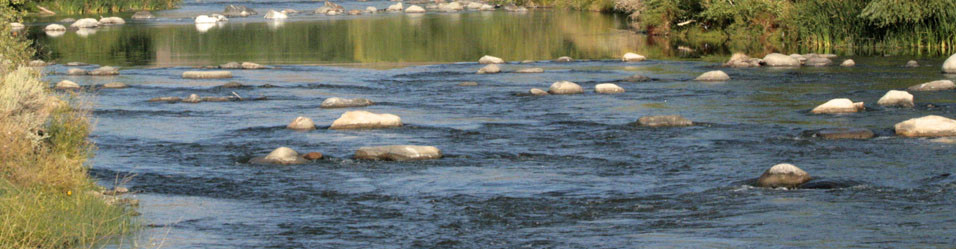
Truckee River depleted of its flow at the last water intake for the TMWA

Most of us think that if water is coming out of the tap or spraying out of the sprinkler, no problem, right? It can be difficult to associate the water we use in our houses and on our yards with the river – the Truckee River – whence it came.  But every gallon you use in the Truckee Meadows (and many who live in the north valleys, too) comes from the Truckee River.


Galena Creek at Washoe County Galena Creek Park, Spring 2014

Galena Creek at Washoe County Galena Creek Park, Spring 2014

What about groundwater wells, you say?  Ditto.  Our groundwater wells in the Truckee Meadows are primarily filled from the river or its tributaries. Water flows from the western mountains through natural creeks and streams and ditches carry water around the entire valley from the Truckee River providing a way for streams to recharge the groundwater. In the Truckee Meadows itself, our annual precipitation at the airport averages only 7″ a year while evaporation is about 40″.  With so little rainfall in the valley, it is the river and its tributaries that mostly fill our groundwater wells.  Prior to explosive population growth and the ill-advised 1960’s era flood project that destroyed the Vista Marsh on the Truckee, the water table was very high.  Flood irrigation of meadows and pastures through out the “Truckee Meadows” helped to keep it that way. It is safe to say that we are completely dependent on the Truckee River for our water here.

The RGJ article on the largest water users says, “the average household uses 124,000 gallons per year”.  The 2010 census says that the average Washoe County household has about 3.2 persons making the daily water use about 106 gallons per person.  Other cities in the west and southwest use significantly less water with better outdoor landscape ordinances, with Tucson, AZ averaging about 70 gallons per person per day.  If Washoe County and the cities of Reno and Sparks adopted landscape ordinances and incentives to encourage water conservation we could reduce our use by more than 33% in wet and drought years.  So instead of using 20 billion* gallons of water per year, households could reduce that to 13.4 billion gallons saving almost 7 billion gallons per year.

*I made this calculation: According an estimate of the 2013 census figures for Washoe County there were 163,198 households.  So, using the average water use statistic quoted in the RGJ article (which most likely came from TMWA) that would be 124,000 gallons/household X 163,198 households = 20,236,552,000 gallons of water.  Let’s say 20 billion gallons of water (billion with a “b”) or 61,400 acre-feet.  (The number doesn’t include commercial or industrial water users.) 

What can we do to save that water?  The list is long, but key among them is to reduce the amount of turf in your yard beginning with the front lawn.  Businesses and housing developments line streets and common areas with strips of turf that few use, but are big water users (and wasters because it is difficult to water narrow strips of turf).

Strip lawns are big water users with runoff from the narrow strips common.

Strip lawns are big water users with runoff from the narrow strips common.

Could that be a accomplished to save water in cities and towns throughout Nevada? We will have to wait to see what the Governor’s Drought Forum comes up with on a state-wide basis by November (Click here to see the Executive order).  The Forum is top heavy in bureaucrats and includes the huge water agency from Las Vegas, the Southern Nevada Water Authority.  On the positive side, it also includes scientists from UNR and DRI.  Who else?  That remains to be seen since the Governor is yet to announce any citizens interested in conserving water resources statewide.

The Governor’s Drought Forum is expected to produce a list of recommendations and a “Drought Summit” with stakeholders in September of this year.  I’m sure that cutbacks in domestic use will be proposed. How will the Drought Forum address the severe drought in the Truckee River?  Statewide? We all need to be concerned if the forum proposes to create more “storage” in the form of additional reservoirs on already stressed rivers and streams in the region.  Storage can be effective when there is occasional drought, but more reservoirs will likely be ineffective in long-term drought.  In the western climate existing reservoirs are already taking a big chunk out of available water through evaporation.  Mountain reservoirs in our region evaporate at least 3 acre-feet of water per acre of exposed surface.

A better choice for “saving” water is to recognize first that we have allocated too much.  This becomes especially apparent during long-term droughts.  “Water rights” that Truckee Meadows industrial and commercial, residential, and agricultural users technically have don’t actually exist this year.  Agricultural users will probably get less than 1/5th of their “water rights”.  TMWA users are being asked to cut back “at least 10%”, but unstated is that TMWA isn’t actually using all of its “water rights” and that much of those “water rights” couldn’t be delivered because there is physically no water available.  Emphasizing the point that water here is over allocated is that most irrigation ditches will likely be dry by June.  Last year they were dry by August.  Hopefully, this isn’t a trend.

Truckee River in downtown Reno

Truckee River in downtown Reno

Water here is always in short supply.  Western Nevada is a desert that happens to have a miraculous river delivered to us from California’s Sierra Nevada Mountains to our west.  We are indeed fortunate to have this river that sustains us.  Will we be up to the task to keep it flowing?

Truckee River flow cut earliest ever

Driving home the ongoing drought’s historic impact, the flows to the Truckee River from Boca Reservoir are being cut back substantially reducing river flows from 550 CFS (cubic feet per second) to around 250 CFS as of today. According to the RGJ (Drought cuts flow of Boca Reservoir) the Water Master for the Truckee River, Chad Blanchard, is reported to have said, “We are out of useable … storage, which is by far the earliest ever.”

Truckee River flows cut from lack of water

Truckee River flows cut from lack of water

The prior earliest date for such a reduction of flows in the Truckee River was June 5 in 1992 according to the article.  The dismal water situation occurs just as the entire west is living through the warmest January-February-March average temperatures ever recorded.  Lake Tahoe is 3 inches below its rim and no water has flowed from the lake since fall 2014. Tahoe is likely to drop significantly more through next fall.  Snowpack at Tahoe is now officially at 0% of normal.  Snowmelt in the past has often lasted well into summer – but not this year.

Flows in the Truckee River during the late spring and early summer are expected to come from Stampede Reservoir which is dedicated to maintain fisheries and provide a minimal inflow to Pyramid Lake.  The amount of water going to Pyramid Lake, is a fraction of what is needed to maintain the iconic desert lake and we will likely see a steep decline in its lake level  through the fall.  Pyramid has already declined around 22 feet during the past 15 years of drought.

Pyramid Lake Surface Elevation during long-term drought

Pyramid Lake Surface Elevation demonstrating the effects of the ongoing long-term drought

Currently, flows into Pyramid lake are running at about 110 CFS as they have been since fall of 2014.  Most of the Truckee River’s flow during the winter and early spring went instead to Lahontan Reservoir to provide irrigation water to farms at the Newlands Project at Fallon on the Carson River.  The Carson River is currently supplying only 4 CFS (yes – that is a single digit) into Lahontan Reservoir even though the Carson River has about 200 CFS flowing into Carson Valley about 50 or so miles upstream.  Upstream water users on the Carson River consume nearly entire flow the river before it reaches Lahontan Reservoir.  Last summer and fall the Carson River was essentially dry at Lahontan Reservoir.

Despite taking the lion’s share of Truckee River flow since late fall 2014, the Newlands Project farmers still face more cuts in water for 2015 over 2014’s water delivery cuts.  With Lahontan Reservoir now at 1/5 of maximum storage, water in Lahontan could be exhausted well before the end of the irrigation season.  There will be far less water than is needed to meet demand; a substantial number of farmers will likely see no water or greatly reduced water.  The TCID (Truckee River Irrigation District) which runs the Newlands Project warned the remaining farmers in Fernley that they may see no water due to the rapidly dropping Truckee River flows.

Lahontan Valley wetlands – Stillwater National Wildlife Refuge and Carson Lake wetlands area – are supplied by drainage from the farms and direct supply from the Newlands Project will also get little or no water.  The wetlands that historically covered nearly 100,000 acres are a small fraction today and even those reduced areas are threatened this year with the real prospect that no water will be available.

Carson Lake wetlands in Lahontan Valley mostly desiccated in April 2015.

Carson Lake wetlands in Lahontan Valley mostly desiccated in April 2015.


The Truckee River flows from last year were largely supplied by snow that fell in previous years – including the winter of 2011.  The snow of yesteryear is gone; will we pursue the same strategy of hoping for another wet year to “save us”? Will we continue to rely on a 10% reduction when we have zero snow pack in April? Is that really going to be effective in the face of extended drought? Perhaps it’s time to have a new conversation that talks about longer dry scenarios than we’ve ever imagined before.  It is a conversation that appears to be long overdue.


Truckee River Storage April 17, 2015 Storage (Acre-feet) Capacity (Acre-feet) % of Capacity
Stampede Reservoir 44,073 226,500 19.5%
Prosser Reservoir 5,598 29,840 18.8%
Boca Reservoir 8,148 40,870 19.9%
Donner Lake 6,040 9,500 63.6%
Carson River Storage      
Lahontan Reservoir 61,310 295,542 20.7%


Lowest snow pack ever measured in Sierra Nevada

The latest snow survey could more accurately be labeled the dry-land survey.  A site at 6,800 feet in the mountains had no snow at all for the first time since the California Department of Water Resources first did the survey in 1950.  From north to south in the Sierra Nevada Mountains the snow pack is the smallest ever measured.

March 30, 2015 - Graphic of snowpack since 1950

March 30, 2015 – Graphic of snowpack since 1950

One thing that is striking about the above graphic is that big years are what has lulled Californians (and Nevadans) to think our reservoirs and groundwater pumping is just fine – thank you very much.  In our short history we have seen time and again a wet winter to come just in time to offset a run of dry ones.  Whew!

But what if the wet ones stop coming?  Then what.  We are getting a look at just such a scenario now with a 6% of average snowpack following on 3 very, very dry ones. Few ever thought such a situation was in the cards.

With so much water going to human uses from agriculture to cities to industry, the natural environment – our rivers and lakes – take a much bigger hit in droughts.  Much of the replenishment of our natural systems can only occur in exceptionally wet years.  The rest of the time – even in average flow years – the environment experiences an artificial drought as water that normally would fill rivers and lakes instead fills reservoirs and canals and partially recharges depleted groundwater systems.

Stranded fish when Truckee River flows are diverted

Stranded fish when Truckee River flows are diverted to farms – historic photo from UNR Knowledge Center display

Changing our historic over-use of water will be painful – if we choose to take up the challenge of preserving our rivers and lakes.

Truckee Meadows drought: tepid TMWA response, deja vu

Washoe Lake nearly dry in March 2015. Washoe Lake is in the Truckee River watershed.

The Truckee Meadows Water Authority seeks a 10% reduction in water use from all its water customers sighting exceptional drought conditions and sooner reliance on its private drought reservoir storage and local wells. As reported on Fox Channel 11 the drought is “worse then (sic) expected”, according to an unnamed TMWA spokesman, “but, the good news is there will be enough water to get through this year.”

Demands on the Truckee River exceed the rivers ability to keep up. The river is particularly stressed during droughts which could become more common.

Demands on the Truckee River exceed the rivers ability to keep up. The river is particularly stressed during droughts which could become more common.

So defines our water supply strategy, “pray for snow”.

All TMWA customers are under the same voluntary call for water reduction. TMWA recently added about 23,000 water customers when it absorbed Washoe County Water Resources and the South Truckee Meadows General Improvement District. Last year TMWA didn’t ask customers to reduce water use by 10% until nearly August.

While the ten percent reduction is called for across the board of all TMWA customers, it isn’t clear how TMWA will report or monitor how customers respond. Further, the call for voluntary reduction fails to recognize that some are very large consumers of water – especially for outdoor watering – while many customers use significantly less water.  The call for a 10% water use reduction by all customers in August, September and October of 2014 actually resulted in a 7.5% reduction or about 1,100 acre-feet according to TMWA. It remains to be seen whether people will respond for an entire spring, summer and fall season with reduced water use. A couple of days of thunderstorms in August 2014 bringing significant rain to some areas in and around the Truckee Meadows could have helped TMWA achieve the reduction.

TMWA’s call for a cutback of 10% in water use doesn’t address the waste of water that is common throughout the valley.  Automatic sprinklers are notorious for wasting water in my neighborhood with obviously broken pipes, poor installations, and way too long cycle times that lead to serious overland flow into the street.  Reports of these problems to TMWA has yet to yield any fixes since early last summer.  Will TMWA begin to address water waste this year?  

As we move into uncharted territory this summer and fall with a 7% of normal snowpack at Lake Tahoe, the public discussion of growth and water use seem to be far away.  

Waterdownthegutter copyAn RGJ editorial “A low-snow future? We need to Talk: Our View“, raises questions about our current drought and its implications for our water future: “This could be just another wild swing in the Sierra Nevada’s historically fluctuating weather.  Or it could be a sign of things to come?”  Indeed, I’ve posed a similar question in one of my blogs:. The RGJ points out several facts which point in a very troubling direction for our region’s water supply:

  • 120 years of records show the average statewide temperature has risen 3.5º F

  • every year since 1999 had above average temperatures

  • ski areas are closing earlier than ever – even large ski areas like Sugar Bowl on the western slope where huge snow totals were common

  • snow levels have risen 500 feet in elevation in the last 30 years

  • Lake Tahoe will likely not rise above its rim in 2015 sending no water into the Truckee River

  • the average daily minimum temperature in Tahoe City increased 4.2º F in 100 years

What the RGJ failed to mention is also significant.  For example, to most of us who pay attention, the drought has been with us for 15 years with 2 wetter years interspersed.  Or put another way, western Nevada has had 13% above average or wet years and 87% below average or dry years in the last decade and a half. 

Could a shifting climate, warmer winters and summers, and prolonged dry periods change both the way we live as well as dry-up our rivers and lakes? It is going to take serious changes to our water use if the last 15 years are the new “normal”.

The news from the last month gives us a taste (an unpleasant one at that!) of what may become our water future. 

Washoe Lake nearly dry in March 2015. Washoe Lake is in the Truckee River watershed.

Washoe Lake nearly dry in March 2015. Washoe Lake is in the Truckee River watershed.


Reflections on Pyramid Lake exhibit opens at the UNR’s Knowledge Center

The new exhibit at the University of Nevada, Reno’s Mathewson-IGT Knowledge Center opened last night to a packed house in the Wells Fargo Auditorium.

Attendees enjoyed the stories by native-language specialist Ben Aleck and presentation of cultural and environmental issues by Ralph Burns.  Both are members of the Pyramid Lake Paiute Tribe.  Bernard Mergen, who grew up on the shores of Pyramid Lake and is a professor emeritus at George Washington University, offered an historical perspective on Pyramid Lake’s people, the Truckee River, and Pyramid Lake as an icon of western expansion.

Bernard Mergen (Emeritus Professor George Washington University), and Ralph Burns and Ben Aleck of the Pyramid Lake Paiute Tribe offer unique perspectives and stories about fabled Pyramid Lake.

Bernard Mergen (Emeritus Professor George Washington University), and Ralph Burns and Ben Aleck of the Pyramid Lake Paiute Tribe offer unique perspectives and stories about fabled Pyramid Lake.

The exhibit features “paintings, photographs and other artifacts such as cradleboards, baskets, pelican eggs and a rattlesnake from Anaho Island,” according to a press release from UNR.

Reflections on Pyramid Lake Exhibit at UNR Knowledge Center: Tim O'Sullivan photo of Pyramid Lake's Pyramid in 1867

Reflections on Pyramid Lake Exhibit at UNR Knowledge Center: Tim O’Sullivan photo of Pyramid Lake’s Pyramid in 1867

Derby Dam (1905) diverts Truckee River Water away from Pyramid Lake

Derby Dam (1905) diverts Truckee River Water away from Pyramid Lake

Reflections on Pyramid Lake Exhibit at UNR Knowledge Center: Pyramid Lake's Pyramid in 1967

Reflections on Pyramid Lake Exhibit at UNR Knowledge Center: Pyramid Lake’s Pyramid in 1967

The exhibit is open now through September 2015.  It is well worth a visit to UNR’s Mathewson-IGT Knowledge Center.  Paid parking is available on the top floor parking garage on N. Virginia Street.  More information: contact Donnelyn Curtis at Special Collections & University Archives, 775-682-5668 or dcurtis@unr.edu