Author Archives: Dennis Ghiglieri

About Dennis Ghiglieri

My concern for the Truckee River grew over the years. It started with picking up trash and supporting better water quality. I helped create the "living river"plan with other citizens on the Community Flood Coalition; a plan to reduce flood impacts to infrastructure through river restoration and protection of the floodplain. I understand how critical the Truckee River is to the environment – and economy – of our entire region. I'm hoping that through these pages we can all understand our connection to the Truckee River and why we need to protect it.

Possible “Worst Drought in 1200 years” hits home

Despite the brief “ArcStorm” of early February, streams and lakes throughout Nevada and California are shrinking under returned dry weather. Drought conditions have persisted now since 2000 with two above average precipitation years occurring only in 2005 and 2010. I’m writing this in early March 2015 and the prospect of a large series of storms is not on the horizon.

Meanwhile the US Drought Monitor shows large swaths of California and Nevada in the 2 most severe drought categories. In Nevada, 48% of the state is classified as under a “extreme” or “exceptional” drought – the two most severe categories of drought. One year ago that figure stood at 33%. Even more of California is in those categories at 67% – a slight increase from last year. The Sierra Nevada Mountains, the primary watershed for much of California and western Nevada rivers and lakes, is entirely within the “exceptional” drought classification. Sierra snowpack stands at 20% of normal – the second lowest measurement on March 1 since record keeping began in 1950.

Drought Monitor 3-3-2015

Drought Monitor 3-3-2015

However, the length of the drought certainly is approaching – if not already exceeding – an historic level at 15 years. The cause of the drought is pegged on the persistent high pressure ridge west of the coast of California in the eastern Pacific. The question for scientists and public alike resounds: “Is the drought the result of increasing Carbon Dioxide in the atmosphere and increasing temperatures world-wide?”

A new study published in the Journal of Science Advances by NASA scientists says that a “megadrought” will hit the US southwest and central plains later this century and remain for decades. The Washington Post, reporting on the NASA study, quoted Jason Smerdon that after 2050, there is “overwhelming evidence of a dry shift, way drier than the mega-droughts of the 1100s and 1200s. [The cause] is twofold, reductions in rainfall and snowfall. Not just rainfall but soil moisture … and changes in evaporation that dry out the soil much more than normal.” The article quotes Marcia Kemper McNutt, a geophysicist and editor in chief of the journal Science, “We are facing a water situation that hasn’t been seen in California for 1,200 years.”

http://www.climatecentral.org/news/400-ppm-co2-february-2015-18710

Pyramid Lake offers ample proof of an extended drought with steeply declining lake levels since 2000.

Westerners face severe changes in the natural environment as drought continues, since most water resources are already allocated to human uses. Reduced river flows from poor winter snowpack impact Nevadans with dropping levels at Pyramid Lake and Lake Tahoe, dry stretches on the Truckee River as well as the Carson River and Walker River. Wetlands at Stillwater National Wildlife Refuge have already shrunk significantly and negatively affect spring and fall waterfowl and shorebird migration. Pyramid Lake has fallen more than 25 feet in elevation during the 15 year drought. Currently, most of the water in the Truckee River (about 2/3 of the flow) is diverted to farmers in Fallon because the drought has almost dried up the Carson River which under normal snowpack supplies much of the water for farmers.

A Stanford University study just released reports that the most severe droughts in California occur when conditions are both dry and warm and global warming is increasing the probability those two weather events will occur together. As reported in USA Today, the study led by Stanford scientist Noah Diffenbaugh who also said that very dry and warm years together would not occur without humans increasing carbon dioxide in the atmosphere. His study, questioned by some because of its methodology and findings, projected there will be more dry and warm years occurring together in the future.

While it isn’t clear if human-caused climate change is a significant factor in the present drought, it is clear that if it does persist longer, all of the west will face serious consequences. Western fish and wildlife populations could see significant losses as streams, lakes, and wetlands disappear under warm and dry conditions. Likewise, agriculture throughout the west will see declining productivity – even complete loss in some cases. Recreation, a strong and increasingly important economic force in the west, will likely shrink with the dwindling lakes and rivers.

ClimateCentral.org published this graphic from  Scripps Institute of Oceanography showing Carbon Dioxide above 400 ppm.

ClimateCentral.org published this graphic from Scripps Institute of Oceanography showing Carbon Dioxide above 400 ppm.

Carbon Dioxide in the atmosphere is now above 400 parts-per-million – the highest level in at least the last 800,000 years according to Scripps Institute of Oceanography. Levels during those previous 800,000 years ranged from under 200 ppm to highs around 300 ppm. Scientists link warming temperatures to rising Carbon Dioxide levels and studies and models show that rising temperatures tend to make wet places wetter and dry places drier.

We could be in for a long dry spell.

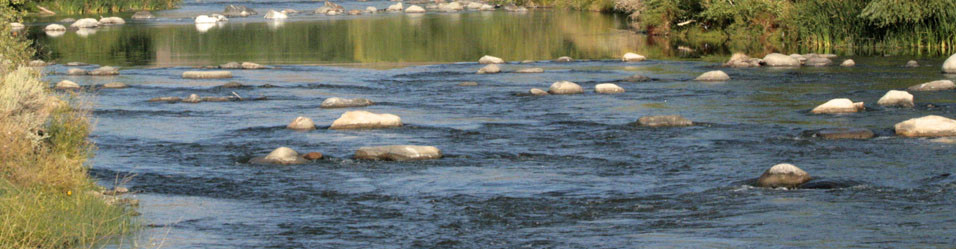
Truckee River, March 2015 - flows of 290 CFS through Reno are substantially below normal river flows.

Truckee River, March 2015 – flows of 290 CFS through Reno are substantially below normal river flows.

[An excellent article online by National Geographic on the California drought and it causes, “Lack of Snow Leaves California’s ‘Water Tower’ Running Low”, is well worth reading.]

AR Storm hits northern California

Not as much precipitation so far here in Nevada.  The forecast call for an 80% chance of rain here in the Truckee Meadows with more rain and snow in the mountains.  Will it make a big enough difference to affect the seriousness of the drought?  Check back on Monday.

Precipitation from Storm, Friday,  2-6-15 at 2.40 PM PST

Precipitation from Storm, Friday, 2-6-15 at 2.40 PM PST

“Atmospheric river” headed to northern California and Nevada? Drought over?

Researchers Zhu and Newell at MIT coined the term “atmospheric river” in a 1998 paper which described the phenomenon where moisture laden air from the warm Pacific streams onto the west coast producing heavy rain in California and western Nevada.  Current forecasts call for such a storm starting Friday of this week.  Where the storm strikes the coast, however, is up in the air – no pun intended.

Evans Canyon - Rancho San Rafael Park - McCarren view south Feb 1986- water pours tunnel shown in lower right

Evans Canyon – Rancho San Rafael Park – McCarren view south Feb 1986- water pours from the tunnel in lower right

Beginning February 11 in 1986 a 10 day series of storms hit northern California and Nevada producing rainfall far beyond what would normally be expected for the month and even many entire winters.  The ARkStorm@Tahoe Project labels this huge storm as an “historic atmospheric river”.  I remember this storm pretty well (with apologies to the local meteorologist, Mike Alger, who warns us against relying on our own experiences when it comes to weather).  My rain gauge for that series of storms recorded over 10 inches of rain over the 10 day period at my house in northwest Reno (with most rain coming toward the end of the storm).  The dry dams on Peavine filled and water cascaded down northwest Reno streets. Flood waters from Evans Creek blocked north Sierra Street and ran through the University and beyond.  If it wasn’t an atmospheric river, it was, at least, a very wet and relatively warm series of storms that produced  wide-spread flooding in Reno as well as throughout northern California.  NOAA has written about this storm (here) and you can even watch loops of satellite images of the storm over the 10 days (here).

Mt Rose with above average snowpack in mid-April 2005 following 5 years of drought and below average snowpacks

Mt Rose with above average snowpack in mid-April 2005 following 5 years of drought and below average snowpacks

February 1969 also produced a reversal of relatively dry winter conditions into a remarkably wet one with record snow depths at Lake Tahoe, record cold in Reno, and the filling of dry Tulare Lake in California’s Central Valley.  I was a volunteer Ski Patrolman at Slide Mountain (now Mt Rose Ski Resort) on weekends at the time, and we were sent up to help resort personnel dig out the central chairlift which was buried by a several day snowfall.  In addition to the remarkable storm in February 1986, February 1969 produced a huge precipitation month in the Sierra and western Nevada as well as in northern California. The Tahoe Tribune 2009 story, “1969 | Tahoes record-setting winter”,  celebrated the 40th anniversary of that memorable winter.  And 1969 is memorable for more than humans.  Biologists G. Gary Scoppettone and Mark Coleman wrote in their 1983 paper “Life History and Status of the Endangered Cui-ui of Pyramid Lake, Nevada”, that 92% of the Cui-ui fish in Pyramid Lake 14 years later were from the fish that were able to reproduce in that exceptional water year of 1969.

Truckee Meadows Flood Management Community Coalition Plan finalization with dignitary, Gail Norton, Secretary of the Interior in 2003.  The Flood Project has been substantially changed and never built but restoration of 4 downstream Truckee River have been completed.

Truckee Meadows Flood Management Community Coalition Plan finalization with dignitary, Gail Norton, Secretary of the Interior in 2003. The Flood Project has been substantially changed and never built but restoration of 4 downstream Truckee River locations have been completed.

January 1997 saw one of the largest floods on the Truckee River every recorded.  It also occurred at a time when Lake Tahoe was already relatively full so the river at its source contributed significant flows downstream. The 1997 storm also qualifies as an “atmospheric river” type storm according to the ARkStorm@Tahoe Project website.  The USGS report describing the historic flood sums it up nicely:

“In late December 1996, storms built up a large snowpack (more than 180 percent of normal) in the higher altitudes of the Sierra Nevada in the Truckee River Basin, Western Nevada and covered the valleys along the eastern Sierra Nevada front as well. Then, a subtropical storm system originating in the central Pacific Ocean near the Hawaiian Islands brought heavy, unseasonably warm rain to the Sierra Nevada from December 30, 1996 through January 3. 1997.”

The snowpack below 7,000 feet mostly melted away and 27.7″ of rain were recorded at Squaw Valley at 8,200 feet elevation.  The results were massive flooding in the Truckee Meadows and sending large flows of water down the Truckee River into Pyramid Lake.  Likewise, the Carson and Walker Rivers in western Nevada also experienced large floods with water inundating Minden and Gardnerville on the Carson River and Yerington on the Walker River.  The future drought that kicked in in 2000 was not foreseen and the community focused instead on flood control.  (The flood was followed by an expensive dredging project throughout the Truckee Meadows that damaged the river environment and produced no lasting benefits to reduce flooding.)

NWS forecast maps for Thurs, Feb 4 through Saturday

NWS forecast maps for Thurs, Feb 4 through Saturday

So, as the “atmospheric river” heads to northern California and, hopefully, Nevada this February 2015, we can all hope that it comes close to the Tahoe area.  I don’t say that to hope for a damaging flood, although that might occur, it is because large storms are really the life-blood of the Truckee River and the Tahoe-Truckee-Pyramid system of Lake-river-Lake.  We can’t escape our need for these large storms for all the good that they do for us and for the ecosystem that depends on them.

Lake Tahoe down 7″ and dropping during our “wettest” month

Drought Monitor for January 20, 2015

Lake Tahoe is a bellwether for the Truckee River.  When it drops below its rim, tough times are on the way.  As of this post, Tahoe’s dropped 7″ below its rim.  A Facebook post from David Bobzien of a photo taken by Steve Tietze underscores the lack of rain and snow.  As Tahoe continues to drop it foretells how serious this drought could be.  If it persists throughout the winter, Tahoe may not even rise to its rim portending a summer of a practically dry Truckee River.  We all need to take this 14 year and continuing drought seriously.

Credit: Steve Tietze Aerial view of the Tahoe outlet into the Truckee River in January 2015

Aerial view of the Tahoe outlet into the Truckee River in January 2015. Snowpack is non-existent.

Demands on the Truckee River exceed the rivers ability to keep up. The river is particularly stressed during droughts which could become more common.

The river is particularly stressed during droughts which could become more common. Here the river near Ivan Sack Park in Reno in the mid-1990s.

Winter to remain dry?

If you’ve been up in the mountains around Reno skiing or driving “over the hill”, you’ve noticed that there isn’t much snow.  Despite the “big” storm in December that brought rain to Reno and some flooding to southern California, there is a poor snowpack that hasn’t seen any real snow or rain added in January – one of the months when you expect frequent storms in California and western Nevada.

Jeff Delong’s front page story in today’s RGJ, “Instead of Sierra snow, January stays ‘bone dry'”, focusses our attention on the super dry conditions that appear to be repeating similar weather from last year and the year before.  Nevertheless, the article fails to mention the elephant in the room – climate change.  Is the evidence beginning to point to a drying and warming due to factors other than natural variation in precipitation? Should we be alarmed?  Or more to the point, why aren’t we alarmed?

Lake Tahoe at Zephyr Cove Pier. Tahoe's water elevation on January 20 stands 7" below its rim so no water can flow into the Truckee River from the Lake.

Lake Tahoe at Zephyr Cove Pier. Tahoe’s water elevation on January 20 stands 7″ below its rim so no water can flow into the Truckee River from the Lake.

The article quotes National Weather Service meteorologist, Scott McGuire saying, “January was bone dry.”  Of course, it is only January 20th, things could turn around.  The article concludes with another quote by McGuire saying, “Things can change pretty quickly and it only takes a handful of big storms. … All we can do is keep our fingers crossed for an active February and March.”

And so goes the planning for climate change induced drying out of the west.

I’m not picking on Scott McGuire either.  He’s simply saying what all of us are thinking, “It better rain and snow soon or we are all in trouble.”  He’s also implying what we all hope – that it has always rained and snowed in the past when we needed it to, right?  So, mother nature, please get on with it.

And, sometimes in the past we have had large storms in February which did change conditions in the mountains dramatically.  I remember in 1969 a very rainy and snowy February which saw huge piles of snow on Slide Mountain which buried the ski lift following a pretty dry winter up to that point.  And, again, in 1986 we saw a late February flood in Reno from rains that went on day after day for more than a week after another less than stellar snow year.  Will there be a big series of storms in February or March that will fill Lake Tahoe and send all thoughts of drought out of our minds?

We can only hope.

Looking toward the west shore of Lake Tahoe from Nevada Beach shows a dismal snow pack in the Sierra on January 20, 2015. January should be a good month for storms, but none have materialized.

Looking toward the west shore of Lake Tahoe from Nevada Beach shows a dismal snow pack in the Sierra on January 20, 2015. January should be a good month for storms, but none have materialized.