Author Archives: Dennis Ghiglieri

About Dennis Ghiglieri

My concern for the Truckee River grew over the years. It started with picking up trash and supporting better water quality. I helped create the "living river"plan with other citizens on the Community Flood Coalition; a plan to reduce flood impacts to infrastructure through river restoration and protection of the floodplain. I understand how critical the Truckee River is to the environment – and economy – of our entire region. I'm hoping that through these pages we can all understand our connection to the Truckee River and why we need to protect it.

Far West US Sept-Oct-Nov 2015 NOAA Forecast: Drought Persists/Intensifies

With fires burning from California to Washington state, westerners are looking for storms bringing rain and snow to offer relief and an end to seemingly endless days of smoky skies.  However, the NOAA Seasonal Drought Outlook isn’t offering much hope for most of the far west including Nevada.

“Although some drought improvement is expected across parts of the Southwest due to increased chances of enhanced September monsoon rainfall and then later from possible enhancement of the autumn subtropical Pacific jet from the strong El Niño, long-term hydrological drought is likely to continue in the Far West. Since SON is a climatologically dry for most of the lower 48 States (although November is wet in the Pacific Northwest), persistence is likely for most of California, except some possible improvement in the southeastern desert.” – NOAA: US Seasonal Drought Outlook (emphasis added)

NOAA Sept-Oct-Nov 2015 Seasonal Drought Outlook.

NOAA Sept-Oct-Nov 2015 Seasonal Drought Outlook.


Comments for the Governor’s Drought Forum

The Truckee River in September 2014 below the Glendale TMWA Treatment Plant is mostly dry.
Pyramid Lake Rephotograph comparison

Pyramid Lake in the 19th Century (L) and Pyramid Lake in the 20th Century (R)

The Truckee River Yacht Club has been around since 1988 and was one of the early players in reshaping the Truckee River Flood Project through public participation. Today we are concerned about the health – even the survivability – of the Truckee River itself. While the Truckee River Yacht Club has no yachts, we have worked on Truckee River protection and in-stream-flows and water quality for more than 2 decades.

We have 3 key questions for the panel today.

  1. Is this a drought that will mimic the droughts of the 19th and 20th centuries? Or is the current dry spell something more?
  2. How will we address the protection of rivers and lakes and wetlands and the fish and wildlife that depend on them? How will the public be educated to conserve the limited water resources of Nevada ?
  3. Who are the leaders to tell Nevadans that the natural water resources of Nevada are tapped out?

We ask that the panel recognize that there are absolute limits on extraction of more water resources from already overstressed rivers and wetlands and groundwater. We also know that today the Truckee River isn’t supplying water except to those who have private storage rights like the TMWA (Truckee Meadows Water Authority, the water agency for Reno-Sparks). We know the “water rights” to use the river and actual “water” are two entirely different things. We also know that groundwater pumping borrows water from hoped for future rains. And we know that the Truckee River and its tributary streams could shrink under increased groundwater pumping.

Of course, the problem isn’t confined to just the Truckee River. The Humboldt River is dry before it reaches Rye Patch Reservoir. The Carson River is a mere trickle at Fort Churchill State Park. The Walker River doesn’t reach Walker Lake – even in average years. Washoe Lake dried up before summer even began.

Washoe Lake nearly dry in March 2015. Washoe Lake is in the Truckee River watershed.

Washoe Lake nearly dry in March 2015. Washoe Lake is in the Truckee River watershed.

The Truckee River was dry or nearly so at the Sparks measuring gauge for 4 days last week and for almost two days a week before that. Despite significant upstream storage capacity on the Truckee River watershed, those reservoirs are mostly depleted. Lake Tahoe stands below its rim – a condition that has now persisted for more than a year resulting in no flow into the Truckee River.

Pyramid Lake has fallen more than 25 feet in the last 15 years of mostly drought conditions. The drop is the result of a deficit of millions of acre-feet of water. Continued losses of water for the Lake threaten the Pyramid Lake Paiute Tribe and the endangered species found there and in the Truckee River.

http://www.climatecentral.org/news/400-ppm-co2-february-2015-18710

Pyramid Lake offers ample proof of an extended drought with steeply declining lake levels since 2000.

Our view of the drought as an inconvenience – almost a distraction – to economic pursuits leads us deeper into our current water problem. Our failure to recognize a drying trend which began firmly at the turn of this current century is part of the problem, too. Another is our denial of climate change – very likely one of the reasons for warming and drying of the western US.

Our rivers, lakes, and wetlands and our uses of water cannot be sustained if the rainfall/snowfall of the past 15 years repeats into the future. Over the next 15 or 50 years, we will have to choose what to keep and what to change. Even in good times, Reno is a desert with only an annual average of 7 inches of precipitation.

We recommend engaging all Nevadans in a discussion of where we go from here. Looking to past solutions will not solve the water crisis we face. We need national and state experts from climatology, hydrology, and natural resources to provide the facts of our current situation and what to expect, most likely, going forward. We need to engage in research to understand how to keep our rivers and lakes intact and functioning, what water uses we can continue, what water uses we need to change, and how to get the public buy-in to carry out necessary solutions.Drought Monitor August 19


[Note – The Governor’s Drought Forum met today at the Nevada Department of Agriculture in Sparks, NV – TRYC wasn’t invited to testify, but we did submit the above comments to the members of the Forum.]

Truckee River goes dry 7-31-15 at Sparks water flow measuring gauge; Returns to 30 CFS by August 3

The meager flow of the Truckee River evaporates completely in Sparks.

In a first for this century, the Truckee River went dry in Sparks on July 31.  It remained at zero flow for around 36 hours, before going up again.  What happened?  Here you can see a dip in the Reno gauge to just 7 CFS for at least 24 hours between noon on July 30 to noon on July 31.  Apparently, the entire flow of the river was then removed at the TMWA Glendale water takeout resulting in no water downstream as measured at the Sparks gauge. (Note: the red * on the graph means that an actual person measured the flow at that site and time.)  Truckee River flow recovered at the Reno gauge to 40 CFS by early morning August 1 (followed by a rapid drop to 15 CFS) and today the river at the Reno gauge is nearly 60 CFS.  However the Sparks gauge remains just a little better than half of that flow as of 5 PM today. Truckee River flows up by August 3 2015Having the river go dry for even a short time is no milestone that anyone would celebrate.  I’m glad that flow has returned to help keep the fish and wildlife along the river surviving (if barely) this summer and into fall.  The rains helped upper elevation vegetation and trees, but have done very little to put water in the river.

In other news, the Governor’s drought forum will be in Sparks, August 19.  Here is the scoop.

08/19/2015
09:00 AM
Water runs off over-irrigated lawn in Reno

Truckee River nearly depleted of its flow at the last water intake for the TMWA in Sparks as seen in Spring 2015

Drought and diversions dry up wetlands

Wetlands that normally have thousands of acres of shallow ponds and marsh lands are nearly completely dry.

Across western Nevada rivers and lakes are taking a big hit during the current drought, but wetlands rarely get a mention.  Wetlands at Stillwater National Wildlife Refuge and Carson Lake and Pasture – managed by the NV Department of Wildlife (NDOW) and the Truckee-Carson Irrigation District (TCID) – sit at the end of the Newlands Irrigation Project fed from the project’s canals and drainage ditches.  Water won’t reach many of these wetlands this year.

I’m reporting information that I received from a conversation that took place on the Nevada Birds listserv managed by the Lahontan Audubon Society-nvbirds@lists.audubon.org as well as from personal observation in Lahontan Valley, the Truckee River, and at Pyramid Lake. Susan Sawyer, Visitor Services Manager, with the US Fish and Wildlife Service at Stillwater National Wildlife Refuge provided definitive information on the current plans for water deliveries to the refuge and beyond in Lahontan Valley.

A narrow strip of water is all that remains of the wetlands at Carson Lake and Pasture in Lahontan Valley in April 2015.

A narrow strip of water is all that remains of the wetlands at Carson Lake and Pasture in Lahontan Valley in April 2015.

“Carson Lake & Pasture (CL&P) opted not to take any of their water delivery this season…”, Sawyer reported.  The reasons I’m aware of are two-fold.  NDOW can’t get enough water to prevent nesting and resting waterfowl die-offs from botulism as the water dries up.  And the NDOW water will instead be retained in Lahontan Reservoir to maintain the fishery there.  I observed over the last month a rapid shrinking of shallow flooded areas in the CL&P and that the small amount of water has mostly evaporated with water persisting only in channels by the end of April.  The CL&P is a recognized Western Hemisphere Shorebird Preserve and did have some migrating birds in March and April before the water that remained from water deliveries in fall 2014 evaporated leaving most ponds and wetland areas desiccated.

Stillwater National Wildlife Refuge (SNWR), Sawyer reports, are allowed 20% of their “deliveries”, like all water users in the Newlands Project.  While water was slated to arrive on April 15, it was reset to May 1 due to “canal construction”.  Most water users, including the Refuge, will get two water deliveries before water is cutoff in early June or “if TCID determines earlier.”

Stillwater National Wildlife Refuge had little water in late winter 2015.

Stillwater National Wildlife Refuge had little water in late winter 2015.

“All refuge water will go to the sanctuary (areas south of Division Rd) via the Center Canal system,” she writes, but “…[N]o water in Stillwater Pt, or even the small demo wetland at Tule Trail.  We have about 3000 [acre-feet] of water available this year, which equals about 18″ deep on the sanctuary ponds.  This is what is lost through evaporation during July alone, so with another 18″ lost in August, the refuge stands a good chance of being [completely] dry by Fall.”  She concludes by writing, “[n]orth of Division Rd (the open hunt areas) will not receive any water at all; S Nutgrass is a big mudflat now and will be dry by June. So our hunt program will be nonexistent as well.”

The wetlands are critical for many migrating shorebirds for feeding and resting, so with wetland areas dry they will be seriously stressed in late summer and early fall as they make their way south to their wintering areas in Central and South America.

Anaho Island National Wildlife Refuge in Pyramid Lake provides nesting for the American White Pelican.

Anaho Island National Wildlife Refuge (left-center) in Pyramid Lake provides nesting for the American White Pelican.

With little inflow from the Truckee River, Pyramid Lake will shrink further this year repeating a pattern that started in 2000 with little interruption.  Pyramid Lake is host to large numbers of migrating birds in the spring and fall.  Anaho Island National Wildlife Refuge, an island in Pyramid Lake, is one of the critical nesting area for the American White Pelican.  Other nesting birds – snowy egrets, California gulls, double-crested cormorants, and great blue herons – find the Island “home” during the nesting season.  Dropping water levels at Pyramid threaten not only water quality at the famed lake, but also exposes more land making it increasingly likely that predators can reach the Island at some point in the future.

The Truckee River will likely receive no water from Lake Tahoe this year. The once rich wetlands of the Truckee River are gone because early settlers and those who followed them dried them up to support industry and agriculture and flood control.  Few alive today would remember the abundance of wetland birds found in the Vista Marsh of the Truckee Meadows and fewer still would remember the wetlands along the lower Truckee River and the now 75 years gone Winnemucca Lake – Pyramid Lake’s smaller cousin fed from overflows of Pyramid Lake itself.  The lower Truckee River had an abundance of bird species in its extensive riparian forest in the late 1860’s.  Just a short time later, 40% of those birds were gone.  The lower Truckee has never recovered from the damage inflicted in the 19th and 20th centuries.

The two Google Earth images below demonstrate how dry western Nevada has become.  The top image is from 2006 and the image below it is 2013. To download the full-sized images click.

May 2006 Image showing more normal water conditions in area from Pyramid Lake in the NW to Carson Lake and Pasture in the SE of the image.

May 2006 Image showing more normal water conditions in area from Pyramid Lake in the NW to Carson Lake and Pasture in the SE of the image.

June 2013 Image showing dry conditions in area from Pyramid Lake in the NW to Carson Lake and Pasture in the SE of the image.  Today's image would show significantly drier conditions yet.

June 2013 Image showing dry conditions in area from Pyramid Lake in the NW to Carson Lake and Pasture in the SE of the image. Today’s image would show significantly drier conditions yet.
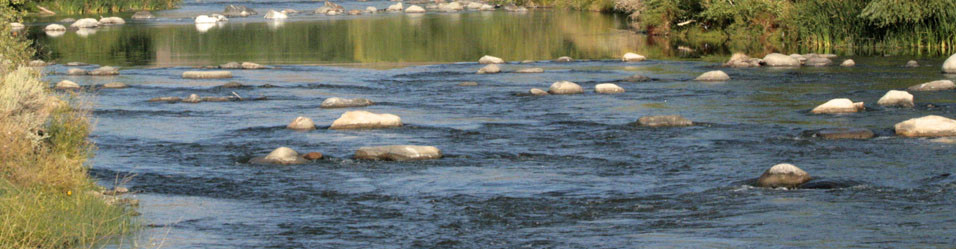
Cutthroat Trout spawning in Truckee River after 77 year hiatus

The Pyramid Lake strain of Lahontan Cutthroat Trout has spawned successfully in the Truckee River after an 77 year absence.

Fish surveys by the US Fish and Wildlife Service in the Truckee River show that 1,000 “baby” cutthroat trout are survivors from the successful spring 2014 spawning run.  This is the first time that the famed trout has successfully spawned in the Truckee River since 1938.  See Jeff Delong’s story in the RGJ here.

Fisherman at Warrior Point at Pyramid Lake

Fisherman at Warrior Point, Pyramid Lake